Maybe while browsing you stumbled over the term “decarboxylation” and asked yourself: what is actually behind it? Don't worry – you are not alone, and we will explain it to you step by step. In the process you will learn not only why this process is so crucial for cannabis, but also how it works and which methods exist to carry it out safely and efficiently.
Cannabinoids and cannabinoid acids: the difference makes the effect
More than 100 different cannabinoids have now been discovered in the cannabis plant. The best known are THC (tetrahydrocannabinol) and CBD (cannabidiol).
Directly after harvest, however, these substances are not in their active form. For example, fresh flowers do not contain THC directly, but THCa – the “a” stands for “acid”.
Only through decarboxylation does THCa become the well-known THC that can unfold its full effect. The same applies to CBDa, which transforms into CBD.
Tip: alongside cannabinoids, terpenes also play a role in effect and taste. They break down easily at excessive heat, so a controlled approach is worthwhile.
Activating the active compounds: how the effect comes about
Decarboxylation therefore ensures that the cannabinoid acids pass into their active form.
- Heat releases small molecules such as carbon dioxide from the compounds.
- This allows THC, CBD and other cannabinoids to act in the body.
If you already take finished medical cannabis products, this step is usually already done. Flowers for personal use, on the other hand, need to be decarboxylated if you do not smoke or vaporise them.
How does decarboxylation work?
Decarboxylation is the central step that converts the inactive cannabinoids into their active form – always, in principle, through heating. Only heat triggers the chemical reaction in which a small molecule of carbon dioxide (CO₂) is split off. This split changes the chemical structure of the cannabinoids, so that THCa becomes THC and CBDa becomes CBD – the forms that can then unfold their well-known effects.
Without this process, the cannabinoids remain largely inactive. That means if you use the flowers raw, the full effect of THC or CBD does not develop.
Smoking or vaporising takes over this process automatically: the heat activates the cannabinoids directly during inhalation. Other applications, such as making cannabis butter or oils, require a targeted and controlled heating so that the cannabinoids are fully activated without being destroyed by excessive temperatures.
Decarboxylation in everyday life: practical methods
1. Preparing tea – simple and mild
An uncomplicated method for beginners is to brew the flowers as a tea.
- Chop up the flowers and boil them for at least 15 minutes in hot water.
- Drink the tea while it is still warm. Honey can help against the bitter taste.
Note: the uptake of active compounds is lower here than with direct inhalation, since THC is only partially water-soluble.
2. Smoking and vaporiser – using heat directly
When smoking, the heat of the flame automatically decarboxylates the cannabinoids. The temperature when burning a cannabis flower is high enough to convert THCa into THC and CBDa into CBD, so that the active compounds take effect immediately. However, this method has a clear disadvantage: combustion produces harmful substances such as tar and other carcinogens that can burden the lungs. In addition, some sensitive terpenes responsible for aroma and effect profile are lost through the high heat.
Vaporisers are a healthier alternative and are therefore particularly recommended for medical use. The devices heat the flowers in a controlled way to a temperature that is high enough to decarboxylate the cannabinoids but low enough to avoid combustion products.
- The cannabinoids are inhaled as vapour, which is far gentler on the airways.
- Thanks to the lower temperatures, terpenes are largely preserved, which supports the taste and the whole effect spectrum of the flowers.
- Depending on the device and temperature setting, you can even specifically control which cannabinoids or terpenes are released most strongly.
3. Decarboxylation before further processing
If you want to make cannabis butter, oils or other products, you have to control the decarboxylation deliberately. Two methods have proven themselves in practice:
a) Oven – simple but smell-intensive
- Preheat the oven to about 110 °C.
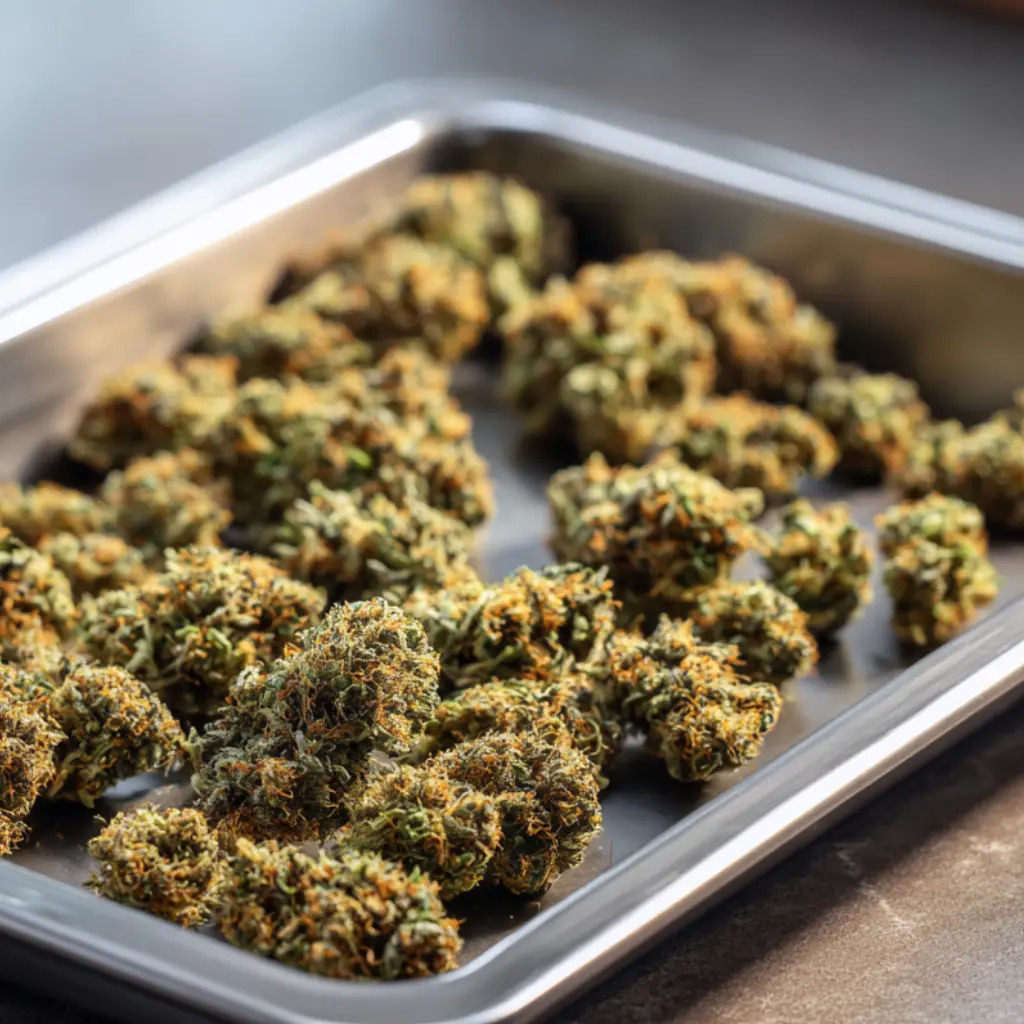
- Chop the flowers evenly and place them on a baking tray.
- Heat for 35–60 minutes (depending on size and moisture).
- Flowers slightly brownish? Then let them cool and process further.
Tip: an oven thermometer helps to keep the temperature precise.
b) Water bath in a vacuum bag – low-odour
- Put chopped flowers into a sous-vide bag.
- Heat in a water bath at 95 °C for about 60 minutes.
- Let cool, then process further.
Advantages: even heating, hardly any smell. Disadvantage: special equipment required.
c) Not recommended: microwave
- Fast, but hard to control.
- Risk that valuable terpenes and cannabinoids burn.
Conclusion: which method suits you?
For medical cannabis patients there are several ways to carry out decarboxylation – depending on how you want to use the flowers.
- Smoking or vaporiser: here the activation of the cannabinoids happens practically automatically. Just consume, and the active compounds are directly available to you – especially handy if you want a quick effect.
- Oven or water bath: these methods are ideal if you want to process the flowers into oils, butter or other products. They allow controlled heating so that the cannabinoids are fully activated without losing valuable terpenes.
- Dedicated decarboxylation devices: there are now also electronic devices developed specifically for decarboxylation. They offer precise temperature control, often work with little odour and enable a simple, safe activation of the cannabinoids.
Which method suits you best depends on your needs, your experience and your equipment. What matters is: there is no “wrong” way, as long as you handle the flowers carefully and keep an eye on the temperature.
If you are unsure, talk to your doctor beforehand.
FAQs: briefly explained
How do you decarboxylate without odour?
The lowest-odour method is in a vacuum bag and water bath, or with devices designed specifically for decarboxylation.
What is decarboxylation?
A process in which cannabinoid acids such as THCa or CBDa are converted by heat into the active form (THC, CBD).
How long does decarboxylation take?
- In the oven: about 35–60 minutes
- In the water bath: about 60 minutes
- Microwave: faster, but not recommended